| |  | Leading Change by John P. Kotter 4.6 on Amazon 3,919 ratings John Kotter, the world's foremost expert on business leadership, distills twenty-five years of experience into Leading Change. A must-have for any organization, this visionary and very personal audiobook is at once inspiring, clear-headed, and filled with important implications for the future.
The pressures on organizations to change will only increase over the next decades. Yet the methods managers have used to strengthen their companies—total quality management, reengineering, right sizing, restructuring, cultural change, and turnarounds—routinely fall short. In Leading Change, Kotter identifies an eight-step process that every company must go through to achieve its goal, and shows where and how people—good people—often derail. Emphasizing again and again the critical need for leadership to make change happen, Leading Change provides unprecedented access to our generation's business master and a positive role model for leaders to emulate. |  | Switch; How to Change Things When Change Is Hard by Chip & Dan Heath 4.6 on Amazon 5,761 ratings Why is it so hard to make lasting changes in our companies, in our communities, and in our own lives?
The primary obstacle is a conflict that’s built into our brains, say Chip and Dan Heath, authors of the critically acclaimed bestseller Made to Stick. Psychologists have discovered that our minds are ruled by two different systems—the rational mind and the emotional mind—that compete for control. The rational mind wants a great beach body; the emotional mind wants that Oreo cookie. The rational mind wants to change something at work; the emotional mind loves the comfort of the existing routine. This tension can doom a change effort—but if it is overcome, change can come quickly.
In Switch, the Heaths show how everyday people—employees and managers, parents and nurses—have united both minds and, as a result, achieved dramatic results: - The lowly medical interns who managed to defeat an entrenched, decades-old medical practice that was endangering patients.
- The home-organizing guru who developed a simple technique for overcoming the dread of housekeeping.
- The manager who transformed a lackadaisical customer-support team into service zealots by removing a standard tool of customer service
In a compelling, story-driven narrative, the Heaths bring together decades of counterintuitive research in psychology, sociology, and other fields to shed new light on how we can effect transformative change. Switch shows that successful changes follow a pattern, a pattern you can use to make the changes that matter to you, whether your interest is in changing the world or changing your waistline.. |  | Influencer; The New Science of Leading Change by Joseph Grenny 4.6 on Amazon 1,771 ratings Change your company. Change the lives of others. Change the world. An Influencer leads change. An Influencer replaces bad behaviors with powerful new skills. An Influencer makes things happen. This is what it takes to be an influencer. Whether you're a CEO, a parent, or merely a person who wants to make a difference, you probably wish you had more influence with the people in your life. But most of us stop trying to make change happen because we believe it is too difficult, if not impossible. We learn to cope rather than learning to influence. From the best-selling authors who taught the world how to have Crucial Conversations comes the new edition of Influencer, a thought-provoking book that combines the remarkable insights of behavioral scientists and business leaders with the astonishing stories of high-powered influencers from all walks of life. You'll be taught each and every step of the influence process - including robust strategies for making change inevitable in your personal life, your business, and your world. You'll learn how to: - Identify high-leverage behaviors that lead to rapid and profound change
- Apply strategies for changing both thoughts and actions
- Marshal six sources of influence to make change inevitable
Influencer takes you on a fascinating journey from San Francisco to Thailand to South Africa, where you'll see how seemingly "insignificant" people are making incredibly significant improvements in solving problems others would think impossible. You'll learn how savvy folks make change not only achievable and sustainable, but inevitable. You'll discover breakthrough ways of changing the key behaviors that lead to greater safety, productivity, quality, and customer service. No matter who you are or what you do, you'll never learn a more valuable or important set of principles and skills. Once you tap into the power of influence, you can reach out and help others work smarter, grow faster, live, look, and feel better--and even save lives. The sky is the limit...for an Influencer. | 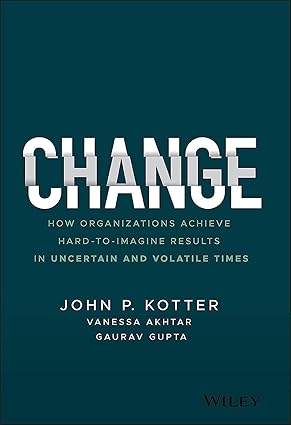 | Change; How Organizations Achieve Hard-to-Imagine Results in Uncertain and Volatile Times by John P. Kotter 4.5 on Amazon 291 ratings Transform your organization with speed and efficiency using this insightful new resource Incremental improvement is no longer sufficient in helping organizations navigate the complexity, uncertainty and volatility of today's world. In Change: How Organizations Achieve Hard-to-Imagine Results in Uncertain and Volatile Times, authors John P. Kotter, Vanessa Akhtar, and Gaurav Gupta explore how to create non-linear, dramatic change in your organization. You'll discover the emerging science of change that teaches us about how to build organizations – from businesses to governments – that change and adapt rapidly. In Change you'll discover: - Why the ability of organizations to deal with threats and take advantage of opportunities in the face of ever greater complexity and uncertainty is being severely challenged
- In-depth, evidence-based, actionable solutions for dealing with institutional resistance to change
- Case studies and success stories that describe organizations who have successfully built the ability to change quickly into their DNA
- A universal approach for how to dramatically improve outcomes from various change efforts, including: strategy execution, digital transformation, restructuring, and more
Perfect for managers, executives, and leaders at companies of all types and sizes, Change will also prove to be a valuable asset to other professionals who serve these organizations. This book is for anyone seeking a proven approach for delivering fast, sustainable and comprehensive results. |  | The Fifth Discipline; The Art & Practice of The Learning Organization by Peter M. Senge 4.6 on Amazon 2675 ratings MORE THAN ONE MILLION COPIES IN PRINT • “One of the seminal management books of the past seventy-five years.”—Harvard Business Review
This revised edition of the bestselling classic is based on fifteen years of experience in putting Peter Senge’s ideas into practice. As Senge makes clear, in the long run the only sustainable competitive advantage is your organization’s ability to learn faster than the competition. The leadership stories demonstrate the many ways that the core ideas of the Fifth Discipline, many of which seemed radical when first published, have become deeply integrated into people’s ways of seeing the world and their managerial practices.
Senge describes how companies can rid themselves of the learning blocks that threaten their productivity and success by adopting the strategies of learning organizations, in which new and expansive patterns of thinking are nurtured, collective aspiration is set free, and people are continually learning how to create the results they truly desire.
Mastering the disciplines Senge outlines in the book will:
• Reignite the spark of genuine learning driven by people focused on what truly matters to them
• Bridge teamwork into macrocreativity
• Free you of confining assumptions and mindsets
• Teach you to see the forest and the trees
• End the struggle between work and personal time
This updated edition contains more than one hundred pages of new material based on interviews with dozens of practitioners at companies such as BP, Unilever, Intel, Ford, HP, and Saudi Aramco and organizations such as Roca, Oxfam, and The World Bank. |  | Change by Design; How Design Thinking Transforms Organizations and Inspires Innovation by Tim Brown 4.6 on Amazon 606 ratings The subject of “design thinking” is the rage at business schools, throughout corporations, and increasingly in the popular press—due in large part to the work of IDEO, a leading design firm, and its celebrated CEO, Tim Brown, who uses this book to show how the techniques and strategies of design belong at every level of business.
The myth of innovation is that brilliant ideas leap fully formed from the minds of geniuses. The reality is that most innovations come from a process of rigorous examination through which great ideas are identified and developed before being realized as new offerings and capabilities. Change by Design explains design thinking, the collaborative process by which the designer’s sensibilities and methods are employed to match people’s needs, not only with what is technically feasible, but what is viable to the bottom line. Design thinking converts need into demand. It’s a human-centered approach to problem solving that helps people and organizations become more innovative and more creative. Introduced a decade ago, the concept of design thinking remains popular at business schools, throughout corporations, and increasingly in the popular press—due in large part to work of IDEO, the undisputed world leading strategy, innovation, and design firm headed by Tim Brown. As he makes clear in this visionary guide—now updated with addition material, including new case studies, and a new introduction—design thinking is not just applicable to so-called creative industries or people who work in the design field. It’s a methodology that has been used by organizations such as Kaiser Permanente, to increase the quality of patient care by re-examining the ways that their nurses manage shift change, or Kraft, to rethink supply chain management. Change by Design is not a book by designers for designers; it is a book for creative leaders seeking to infuse design thinking into every level of an organization, product, or service to drive new alternatives for business and society. . |  | Turn the Ship Around!: A True Story of Turning Followers into Leaders by L. David Marquet 4.7 on Amazon 9296 ratings Since Turn the Ship Around! was published in 2013, hundreds of thousands of readers have been inspired by former Navy captain David Marquet’s true story. Many have applied his insights to their own organizations, creating workplaces where everyone takes responsibility for his or her actions, where followers grow to become leaders, and where happier teams drive dramatically better results. Marquet was a Naval Academy graduate and an experienced officer when selected for submarine command. Trained to give orders in the traditional model of “know all-tell all” leadership, he faced a new wrinkle when he was shifted to the Santa Fe, a nuclear-powered submarine. Facing the high-stress environment of a sub where there’s little margin for error, he was determined to reverse the trends he found on the Santa Fe: poor morale, poor performance, and the worst retention rate in the fleet. Almost immediately, Marquet ran into trouble when he unknowingly gave an impossible order and his crew tried to follow it anyway. When he asked why, the answer was: “Because you told me to.” Marquet realized that while he had been trained for a different submarine, his crew had been trained to do what they were told - a deadly combination. That’s when Marquet flipped the leadership model on its head and pushed for leadership at every level. Turn the Ship Around! reveals how the Santa Fe skyrocketed from worst to first in the fleet by challenging the US Navy’s traditional leader-follower approach. Struggling against his own instincts to take control, he instead achieved the vastly more powerful model of giving control to his subordinates and creating leaders. Before long, each member of Marquet’s crew became a leader and assumed responsibility for everything he did, from clerical tasks to crucial combat decisions. The crew became completely engaged, contributing their full intellectual capacity every day. The Santa Fe set records for performance, morale, and retention. And over the next decade, a highly disproportionate number of the officers of the Santa Fe were selected to become submarine commanders. Whether you need a major change of course or just a tweak of the rudder, you can apply Marquet’s methods to turn your own ship around. |  | It's Your Ship; Management Techniques from the Best Damn Ship in the Navy by Captain D. Michael Abrashoff 4.7 on Amazon 4200 ratings The legendary New York Times bestselling tale of top-down change for anyone trying to navigate today's uncertain business seas.
When Captain Abrashoff took over as commander of USS Benfold, it was like a business that had all the latest technology but only some of the productivity. Knowing that responsibility for improving performance rested with him, he realized he had to improve his own leadership skills before he could improve his ship. Within months, he created a crew of confident and inspired problem-solvers eager to take the initiative and responsibility for their actions. The slogan on board became "It's your ship," and Benfold was soon recognized far and wide as a model of naval efficiency. How did Abrashoff do it? Against the backdrop of today's United States Navy, Abrashoff shares his secrets of successful management including: - See the ship through the eyes of the crew: By soliciting a sailor's suggestions, Abrashoff drastically reduced tedious chores that provided little additional value.
- Communicate, communicate, communicate: The more Abrashoff communicated the plan, the better the crew's performance. His crew eventually started calling him "Megaphone Mike," since they heard from him so often.
- Create discipline by focusing on purpose: Discipline skyrocketed when Abrashoff's crew believed that what they were doing was important.
- Listen aggressively: After learning that many sailors wanted to use the GI Bill, Abrashoff brought a test official aboard the ship-and held the SATs forty miles off the Iraqi coast.
From achieving amazing cost savings to winning the highest gunnery score in the Pacific Fleet, Captain Abrashoff's extraordinary campaign sent shock waves through the U.S. Navy. It can help you change the course of your ship, no matter where your business battles are fought. |  | The Fearless Organization; Creating Psychological Safety in the Workplace for Learning, Innovation, and Growth by Amy C. Edmondson 4.6 on Amazon 1920 ratings Conquer the most essential adaptation to the knowledge economy The Fearless Organization offers practical guidance for teams and organizations who are serious about success in the modern economy. With so much riding on innovation, creativity, and spark, it is essential to attract and retain quality talent - but what good does this talent do if no one is able to speak their mind? The traditional culture of "fitting in" and "going along" spells doom in the knowledge economy. Success requires a continuous influx of new ideas, new challenges, and critical thought, and the interpersonal climate must not suppress, silence, ridicule, or intimidate. Not every idea is good, and yes, there are stupid questions, and yes, dissent can slow things down, but talking through these things is an essential part of the creative process. People must be allowed to voice half-finished thoughts, ask questions from left field, and brainstorm out loud; it creates a culture in which a minor flub or momentary lapse is no big deal and where actual mistakes are owned and corrected, and where the next left-field idea could be the next big thing. This audiobook explores this culture of psychological safety and provides a blueprint for bringing it to life. The road is sometimes bumpy, but succinct and informative scenario-based explanations provide a clear path forward to constant learning and healthy innovation. |  | The Catalyst; How to Change Anyone's Mind by Jonah Berger 4.6 on Amazon 1343 ratings Everyone has something they want to change. Marketers want to change their customers’ minds and leaders want to change organizations. Start-ups want to change industries and nonprofits want to change the world. But change is hard. Often, we persuade and pressure and push, but nothing moves. Could there be a better way?
This book takes a different approach. Successful change agents know it’s not about pushing harder, or providing more information, it’s about being a catalyst. Catalysts remove roadblocks and reduce the barriers to change. Instead of asking, “How could I change someone’s mind?” they ask a different question: “Why haven’t they changed already? What’s stopping them?”
The Catalyst identifies the key barriers to change and how to mitigate them. You’ll learn how catalysts change minds in the toughest of situations: how hostage negotiators get people to come out with their hands up and how marketers get new products to catch on, how leaders transform organizational culture and how activists ignite social movements, how substance abuse counselors get addicts to realize they have a problem, and how political canvassers change deeply rooted political beliefs.
This book is designed for anyone who wants to catalyze change. It provides a powerful way of thinking and a range of techniques that can lead to extraordinary results. Whether you’re trying to change one person, transform an organization, or shift the way an entire industry does business, this book will teach you how to become a catalyst.. | 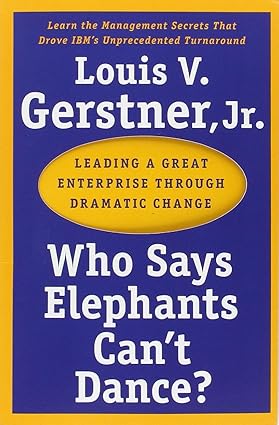 | Who Says Elephants Can't Dance?: Inside IBM's Historic Turnaround by Louis V. Gerstner Jr. 4.5 on Amazon 1343 ratings Who Says Elephants Can't Dance? sums up Lou Gerstner's historic business achievement, bringing IBM back from the brink of insolvency to lead the computer business once again.Offering a unique case study drawn from decades of experience at some of America's top companies -- McKinsey, American Express, RJR Nabisco -- Gerstner's insights into management and leadership are applicable to any business, at any level. Ranging from strategy to public relations, from finance to organization, Gerstner reveals the lessons of a lifetime running highly successful companies. |  | Humanocracy; Creating Organizations as Amazing as the People Inside Them by Gary Hamel, Michele Zanini 4.6 on Amazon 637 ratings In a world of unrelenting change and unprecedented challenges, we need organizations that are resilient and daring. Unfortunately, most organizations, overburdened by bureaucracy, are sluggish and timid. In the age of upheaval, top-down power structures and rule-choked management systems are a liability. They crush creativity and stifle initiative. As leaders, employees, investors, and citizens, we deserve better. We need organizations that are bold, entrepreneurial, and as nimble as change itself. Hence this book. In Humanocracy, Gary Hamel and Michele Zanini make a passionate, data-driven argument for excising bureaucracy and replacing it with something better. Drawing on more than a decade of research and packed with practical examples, Humanocracy lays out a detailed blueprint for creating organizations that are as inspired and ingenious as the human beings inside them. Critical building blocks include: - Motivation: Rallying colleagues to the challenge of busting bureaucracy
- Models: Leveraging the experience of organizations that have profitably challenged the bureaucratic status quo
- Mindsets: Escaping the industrial age thinking that frustrates progress
- Mobilization: Activating a pro-change coalition to hack outmoded management systems and processes
- Migration: Embedding the principles of humanocracy - ownership, markets, meritocracy, community, openness, experimentation, and paradox - in your organization's DNA
If you've finally run out of patience with bureaucratic bullshit....
If you want to build an organization that can outrun change....
If you're committed to giving every team member the chance to learn, grow, and contribute... ...then this book's for you. Whatever your role or title, Humanocracy will show you how to launch an unstoppable movement to equip and empower everyone in your organization to be their best and to do their best. The ultimate prize: an organization that's fit for the future and fit for human beings. |  | Master of Change; How to Excel When Everything Is Changing – Including You by Brad Stulberg 4.6 on Amazon 570 ratings A revelatory book on rethinking change and creating a rugged and flexible mindset amidst life's intensifying flux. From social disruptions like economic recessions, pandemics, and new technologies to individual disruptions like getting married, career transitions, and becoming a parent, we undergo change and transformation—both good and bad—regularly. Change is not the exception, it’s the rule. Yet we endlessly fight it, often viewing it as a threat to our stability and sense of self. Master of Change flips this script on its head and offers a path for embracing and even growing from life’s constant instability. Brad Stulberg, sustainable excellence expert, coach, and bestselling author of The Practice of Groundedness,offers a new model that describes change as an ongoing cycle of order, disorder, and reorder—yes, we return to stability, but that stability is somewhere new. Drawing on modern science, ancient wisdom, and daily practice, Stulberg offers concrete principles for developing a mindset called rugged flexibility, along with habits and practices to implement it. Along the way, Stulberg reveals: - How to be in conversation with change instead of it happening to you.
- The importance of expectations
- Why cultivating a rugged yet flexible sense of self is key to a strong identity.
- How to take productive action during a challenge.
- The paradox of both making meaning and moving forward.
In the end, Stulbergreshapes our entire perception of change and shows us how to grow in its midst—ultimately helping us move forward better, stronger, and wiser than we were before. . | 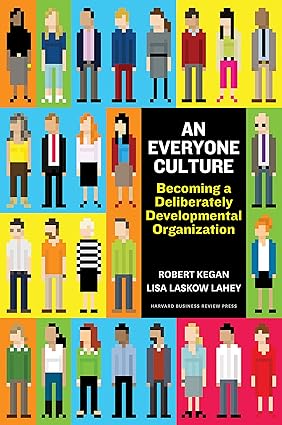 | An Everyone Culture; Becoming a Deliberately Developmental Organization by Robert Kegan, Lisa Laskow Lahey 4.6 on Amazon 470 ratings A Radical New Model for Unleashing Your Company’s Potential What if a company did everything in its power to create a culture in which everyone could overcome their own internal barriers to change and use errors and vulnerabilities as prime opportunities for personal and company growth? Robert Kegan and Lisa Laskow Lahey have found and studied such companies - deliberately developmental organizations. A DDO is organized around the conviction that organizations will best prosper when they are more deeply aligned with people's strongest motive, which is to grow. This means going beyond consigning "people development" to high-potential programs, executive coaching, or once-a-year off-sites. It means fashioning an organizational culture in which support of people's development is woven into the daily fabric of working life and the company's regular operations, daily routines, and conversations. An Everyone Culture dives deep into the worlds of three leading companies that embody this breakthrough approach. It reveals the design principles, concrete practices, and underlying science at the heart of DDOs - from their disciplined approach to giving feedback to how they use meetings to the distinctive way that managers and leaders define their roles. |  | Designed for Digital; How to Architect Your Business for Sustained Success by Jeanne W. Ross, Cynthia M. Beath, Martin Mocker 4.6 on Amazon 319 ratings How to redesign ‘big, old’ companies for digital transformation and success—with examples from 300+ business leaders and 30+ organizations, including Amazon Uber, LEGO, and Toyota.
Most established companies have deployed such digital technologies as the cloud, mobile apps, the internet of things, and artificial intelligence. But few established companies are designed for digital. Full of practical advice and real-life examples of digital transformation, this book is an essential guide for retooling organizations for digital success through 5 key building blocks:
• Shared Customer Insights
• Operational Backbone
• Digital Platform
• Accountability Framework
• External Developer Platform
In the digital economy, rapid pace of change in technology capabilities and customer desires means that business strategy must be fluid. As a result, business design has become a critical management responsibility. Effective business design enables a company to quickly pivot in response to new competitive threats and opportunities. Most leaders today, however, rely on organizational structure to implement strategy, unaware that structure inhibits, rather than enables, agility. In companies that are designed for digital, people, processes, data, and technology are synchronized to identify and deliver innovative customer solutions—and redefine strategy. Digital design, not strategy, is what separates winners from losers in the digital economy.
Designed for Digital includes case studies from Amazon, BNY Mellon, DBS Bank, LEGO, Philips, Schneider Electric, USAA, and many other global organizations. Drawing on 5 years of research, the book is an essential guide for companies that want to disrupt rather than be disrupted in the new digital landscape. | 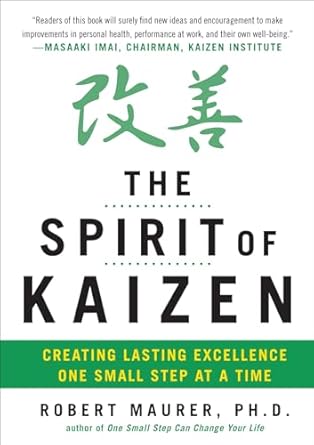 | The Spirit of Kaizen Creating Lasting Excellence One Small Step at a Time by Bob Maurer, Leigh Ann Hirschman 4.6 on Amazon 228 ratings Discover the power of KAIZEN to make lasting and powerful change in your organization The easy-to-implement guide to driving organizational change by applying the proven concept of kaizen UCLA psychologist and organizational consultant Dr. Robert Maurer provides a simple and proven effective technique for making major changes with minimal disruption. Applying the operational concept of kaizen - small, continual improvements - to common management challenges, managers can drive major improvements with a series of well-planned techniques for boosting quality, innovation, sales, and morale. |  | Beyond Performance 2.0; A Proven Approach to Leading Large-Scale Change by Scott Keller Double your odds of leading successful, sustainable change Leaders aren't short on access to change management advice, but the jury has long been out as to which approach is the best one to follow. With the publication of Beyond Performance 2.0, the verdict is well and truly in. By applying the approach detailed by authors Scott Keller and Bill Schaninger, the evidence shows that leaders can more than double their odds of success - from 30 percent to almost 80. Whereas the first edition of Beyond Performance introduced the authors' "Five Frames of Performance and Health" approach to change management, the fully revised and updated Beyond Performance 2.0 has been transformed into a truly practical "how to" guide for leaders. Every aspect of how to lead change at scale is covered in a step-by-step manner, always accompanied by practical tools and real-life examples. |  | Doing Agile Right Transformation Without Chaos - Darrell K. Rigby, Sarah Elk, Steven H. Berez 4.5 on Amazon 730 ratings For decades business leaders have been painfully aware of the huge chasm between their aspiration for a nimble, flexible enterprise and the reality of silos, sluggishness, and frustrated innovation. Today, agile is being hailed as the essential bridge across that chasm. Agile, say its enthusiasts, can transform your company, catapulting you to the head of the pack. Not so fast. In this clear-eyed and indispensable audiobook, Sarah Elk and Steve Berez provide a much-needed reality check. They dispel the myths and misconceptions that have accompanied agile's growth - the idea that it can reshape your organization all at once, for instance, or that it should be used in every function and for all types of work. They affirm and illustrate that agile teams can indeed transform the work environment, make people's jobs more rewarding, and turbocharge innovation - but only if the method is fully understood and implemented the right way. Agile, done well, frees and facilitates vigorous innovation without sacrificing the efficiency and reliability essential to traditional operations. The authors break down how agile really works, show what not to do, and explain the crucial importance of scaling agile properly in order to get its full benefit. They then lay out a road map for leading the transition to a truly agile enterprise. |  | Enchantment; The Art of Changing Hearts, Minds, and Actions by Guy Kawasaki 4.2 on Amazon 564 ratings Enchantment, as defined by bestselling business guru Guy Kawasaki, is not about manipulating people. It transforms situations and relationships. It converts hostility into civility and civility into affinity. It changes skeptics and cynics into believers and the undecided into the loyal. Enchantment can happen during a retail transaction, a high-level corporate negotiation, or a Facebook update. And when done right, it’s more powerful than traditional persuasion, influence, or marketing techniques. Kawasaki argues that in business and personal interactions, your goal is not merely to get what you want but to bring about a voluntary, enduring, and delightful change in other people. By enlisting their own goals and desires, by being likable and trustworthy, and by framing a cause that others can embrace, you can change hearts, minds, and actions. |  | Hardwiring Excellence Purpose, Worthwhile Work, Making a Difference by Quint Studer 4.7 on Amazon 477 ratings Hardwiring Excellence offers a road map and practical how-to guide for creating and sustaining a culture of service and operational excellence. In this book, author Quint Studer, CEO of Studer Group, draws on his personal experience as a former hospital executive who led two organizations to the top 1% in patient satisfaction and his experience coaching hundreds of healthcare organizations since. Studer, a nationally acclaimed educator, coach, and thought leader in healthcare today, is a master storyteller, mixing stories with personal insight, simple tools, and in-depth recommendations on how good organizations can become great ones. Based on Studer Group's Nine Principles, Quint Studer shows how to retain more employees; ensure better customer service; build strong leadership, align organizational values, goals, and results; increase communication; reward and recognize individual success while also requiring accountability; and move operational performance for better financials, market share, and growth. At the core of the journey, he says, is a sense of purpose, worthwhile work and making a difference. When organizations learn how to harness this passion in their employees, they create a success spiral with ever increasing momentum. |  | No Rules Rules; Netflix and the Culture of Reinvention by Reed Hastings, Erin Meyer, et al 4.6 on Amazon 7,622 ratings Netflix cofounder Reed Hastings reveals for the first time the unorthodox culture behind one of the world's most innovative, imaginative, and successful companies
There has never before been a company like Netflix. It has led nothing short of a revolution in the entertainment industries, generating billions of dollars in annual revenue while capturing the imaginations of hundreds of millions of people in over 190 countries. But to reach these great heights, Netflix, which launched in 1998 as an online DVD rental service, has had to reinvent itself over and over again. This type of unprecedented flexibility would have been impossible without the counterintuitive and radical management principles that cofounder Reed Hastings established from the very beginning. Hastings rejected the conventional wisdom under which other companies operate and defied tradition to instead build a culture focused on freedom and responsibility, one that has allowed Netflix to adapt and innovate as the needs of its members and the world have simultaneously transformed.
Hastings set new standards, valuing people over process, emphasizing innovation over efficiency, and giving employees context, not controls. At Netflix, there are no vacation or expense policies. At Netflix, adequate performance gets a generous severance, and hard work is irrelevant. At Netflix, you don’t try to please your boss, you give candid feedback instead. At Netflix, employees don’t need approval, and the company pays top of market. When Hastings and his team first devised these unorthodox principles, the implications were unknown and untested. But in just a short period, their methods led to unparalleled speed and boldness, as Netflix quickly became one of the most loved brands in the world.
Here for the first time, Hastings and Erin Meyer, bestselling author of The Culture Map and one of the world’s most influential business thinkers, dive deep into the controversial ideologies at the heart of the Netflix psyche, which have generated results that are the envy of the business world. Drawing on hundreds of interviews with current and past Netflix employees from around the globe and never-before-told stories of trial and error from Hastings’s own career, No Rules Rules is the fascinating and untold account of the philosophy behind one of the world’s most innovative, imaginative, and successful companies. |  | No Point B; Rules for Leading Change in the New Hyper-Connected, Radically Conscious Economy by Caleb Gardner Our future depends on changing the way we change.
But because technology has forever altered our relationship with what's coming next, the tomorrow we envisioned is too often totally different by the time it arrives. How can leaders manage disruption when disruption never stops coming?
Drawing upon his vast experience in business leadership and social activism, author Caleb Gardner shows how the simple idea of embracing constant change as a core competency for living in a complex world could revolutionize our relationship with modernity and transform our approach to effective leadership.
Through stories from his career and advice from experts in sociology, psychology, and management, No Point B proposes nine principles for mobilizing the next generation of effective change leaders, including: focusing on effective communications to navigate our reality-distorting media, building adaptive capability and tackling cross-disciplinary problems, and never resting on our assumptions about how to best navigate the world.
The only way we'll make significant progress on building a better world is by recognizing better is a process of constant adaptation, not an end point. |  | Leverage Change; 8 Ways to Achieve Faster, Easier, Better Results by Robert W. Jake Jacobs Frustrated that change efforts you’re leading take too long, are too difficult, or are too often ineffective? Discover eight powerful ways to make any change work faster, easier, and better—whether done by C-suite leaders or frontline workers.
In a recent Fast Company article, nine CEOs said the biggest challenges their companies face are all related to change. Change is a constant need and challenge for every organization. Too often, people who lead change work are frustrated that it’s too slow, hard or ineffective.
Organizational change doesn't have to be so difficult. Leading change expert Jake Jacobs shares eight fail-safe ways to make any change initiative faster, easier and better. These levers, or smart strategic actions, can be used with the change method you’re already deploying be it PROSCI, Lencioni’s 5 Dysfunctions, Appreciative Inquiry or any other. Think of the levers as making a good thing even better.
Leverage Change is chockful of practical applications and 44 stories, some contributed by Jennifer Brown, author of The Inclusive Leader. Your organization suffering from change fatigue? Then use the Pay Attention to Continuity lever. Change happening too slowly? It’s time to Think and Act as if the Future Were Now!
Leverage is about getting more done with fewer hassles, headaches and problems. Equally applicable to individual, team or organizational change work, Leverage Change is your guidebook to any type of change, in any organization, made by anyone. |  | Good to Great; Why Some Companies Make the Leap...And Others Don't by Jim Collins 4.5 on Amazon 8,987 ratings Built To Last, the defining management study of the nineties, showed how great companies triumph over time and how long-term sustained performance can be engineered into the DNA of an enterprise from the very beginning. But what about companies that are not born with great DNA? How can good companies, mediocre companies, even bad companies achieve enduring greatness? Are there those that convert long-term mediocrity or worse into long-term superiority? If so, what are the distinguishing characteristics that cause a company to go from good to great? Over five years, Jim Collins and his research team have analyzed the histories of 28 companies, discovering why some companies make the leap and others don't. The findings include: - Level 5 Leadership: A surprising style, required for greatness.
- The Hedgehog Concept: Finding your three circles, to transcend the curse of competence.
- A Culture of Discipline: The alchemy of great results.
- Technology Accelerators: How good-to-great companies think differently about technology.
- The Flywheel and the Doom Loop: Why those who do frequent restructuring fail to make the leap.
|  | Good Power: Leading Positive Change in Our Lives, Work, and World by Ginni Rometty 4.6 on Amazon 337 ratings Former IBM CEO Ginni Rometty delivers a powerful combination of memoir, leadership lessons, and big ideas on how we can all drive meaningful change. Ginni Rometty led one of the world's most iconic companies, and in Good Power she recounts her groundbreaking path from a challenging childhood to becoming the CEO of IBM and one of the world's most influential business leaders. With candor and depth, Rometty shares milestones from her life and career while redefining power as a way to drive meaningful change in positive ways for ourselves, our organizations, and for the many, not just the few—a concept she calls "good power." Rometty's "memoir with purpose" combines the experiences that defined her life—personal hurdles, high-stakes decisions, passionate advocacy—with the actionable advice of a coaching session to highlight lessons that shape authentic leadership. Behind-the-scenes stories and practical guidance offer us a blueprint for how we can all use good power to advance our careers, inspire our teams, improve our companies, and create healthier societies. The book begins with raw, vivid memories from Rometty's youth and early professional years as she recalls the trauma and the role models that formed her belief that how we lead is as important as what we achieve. She learns early on that good power is a choice available to everyone, even to those without money, status, or impressive titles. Rometty then shows us how her concept of good power evolved as she grew from a first-time manager to a transformative CEO. Stories told through the lens of five principles—be in service of others; build belief; know what must change and what must endure; steward good tech; be resilient—reveal tools that anyone can apply to achieve real change at any stage of their life and work. Rometty also encourages us to use good power at scale to bring about urgent societal change. She shares insights from her own journey to create a more equitable world by leading the SkillsFirst movement, which connects underserved populations with family-sustaining jobs by transforming hiring, education, and training. With heart, humility, and conviction, Good Power offers an inspiring, compelling guide to creating meaningful change in our lives. |  | Beyond Digital; How Great Leaders Transform Their Organizations and Shape the Future by Paul Leinwand, Mahadeva Matt Mani Two world-renowned strategists detail the seven leadership imperatives for transforming companies in the new digital era. Digital transformation is critical. But winning in today's world requires more than digitization. It requires understanding that the nature of competitive advantage has shifted—and that being digital is not enough. In Beyond Digital, Paul Leinwand and Matt Mani from Strategy&, PwC's global strategy consulting business, take readers inside twelve companies and how they have navigated through this monumental shift: from Philips's reinvention from a broad conglomerate to a focused health technology player, to Cleveland Clinic's engagement with its broader ecosystem to improve and expand its leading patient care to more locations around the world, to Microsoft's overhaul of its global commercial business to drive customer outcomes. Other case studies include Adobe, Citigroup, Eli Lilly, Hitachi, Honeywell, Inditex, Komatsu, STC Pay, and Titan. Building on a major new body of research, the authors identify the seven imperatives that leaders must follow as the digital age continues to evolve: - Reimagine your company's place in the world
- Embrace and create value via ecosystems
- Build a system of privileged insights with your customers
- Make your organization outcome-oriented
- Invert the focus of your leadership team
- Reinvent the social contract with your people
- Disrupt your own leadership approach
Together, these seven imperatives comprise a playbook for how leaders can define a bolder purpose and transform their organizations. | The package comes in 16 GB flash drive at Ksh. 6,500. As usual delivery is free. For order WhatsApp +254 721 663 208 | |



No comments:
Post a Comment